
Walking into a bustling café or a lively neighborhood park, you immediately sense a shared energy—people chatting, exchanging ideas, or simply enjoying each other’s presence. These spaces serve as an extension of our lives beyond home and work. Yet in many cities, they are becoming increasingly rare.
Urban sociologist and professor Ray Oldenburg personally observed community life in cities such as San Jose, Stockholm, and Osaka while developing the original concept of the “third place.” This idea describes social spaces beyond home (the first place) and work (the second place) where people gather, connect, and experience a sense of belonging. These informal environments foster community, creativity, and mutual support. Traditionally, bars and coffee shops have served as third places where people relax, socialize, and build new connections. However, across North America, modern zoning policies and urban planning have increasingly separated residential areas from commercial spaces, resulting in a shortage of high-quality third places, weakening community ties, and limiting in-person interactions.¹ ²
Businesses like Starbucks have attempted to fill this gap by marketing their cafés as third places: spaces where people can relax, meet friends, or make new connections. Yet even as I sit in a coffee shop writing these words, surrounded by others similarly absorbed in their laptops, I can’t help but feel a lingering sense of isolation. A coffee shop full of individuals staring at their screens lacks the spontaneity and warmth of a true third place, where conversations unfold naturally and relationships develop organically. It makes me wonder: What is truly missing in the creation of a third place? Perhaps it is more than just tables and chairs; maybe it requires opportunities for interaction and the right conditions for genuine human connection to emerge.
A true third place brings people from different backgrounds and perspectives together, allowing them to share their stories comfortably and experience a sense of community. Historically, humans have thrived in communal settings. Among Indigenous peoples of the Pacific Northwest, such as many Coast Salish groups, longhouses served as central social spaces, often housing multiple families and functioning as gathering sites for communal activities. Inside these longhouses, a fire in the central aisle created a warm, shared environment where conversation, storytelling, and intergenerational interaction naturally took place.⁴ In Japan, businessmen unwind after work at izakayas, gathering informally with friends or coworkers to have a beer and some light food before heading home, creating a space for people to socialize and respite from life. When I was young, even something as simple as taking the school bus home with classmates created a third place where we gossiped, laughed, and shared snacks before dispersing to our separate lives. Looking back, I realize that the essence of a third place isn’t just about the physical space, it’s about the connections made within it.
As architects and designers, we shape the built environment, and with it, the potential for fostering genuine human connection. The success of a third place often depends on how it is designed taking in regards physically, socially and culturally. Recent urban projects demonstrate how human‑centered redesign turns underused areas into vibrant plazas and streets where neighbors mingle and children play. ³
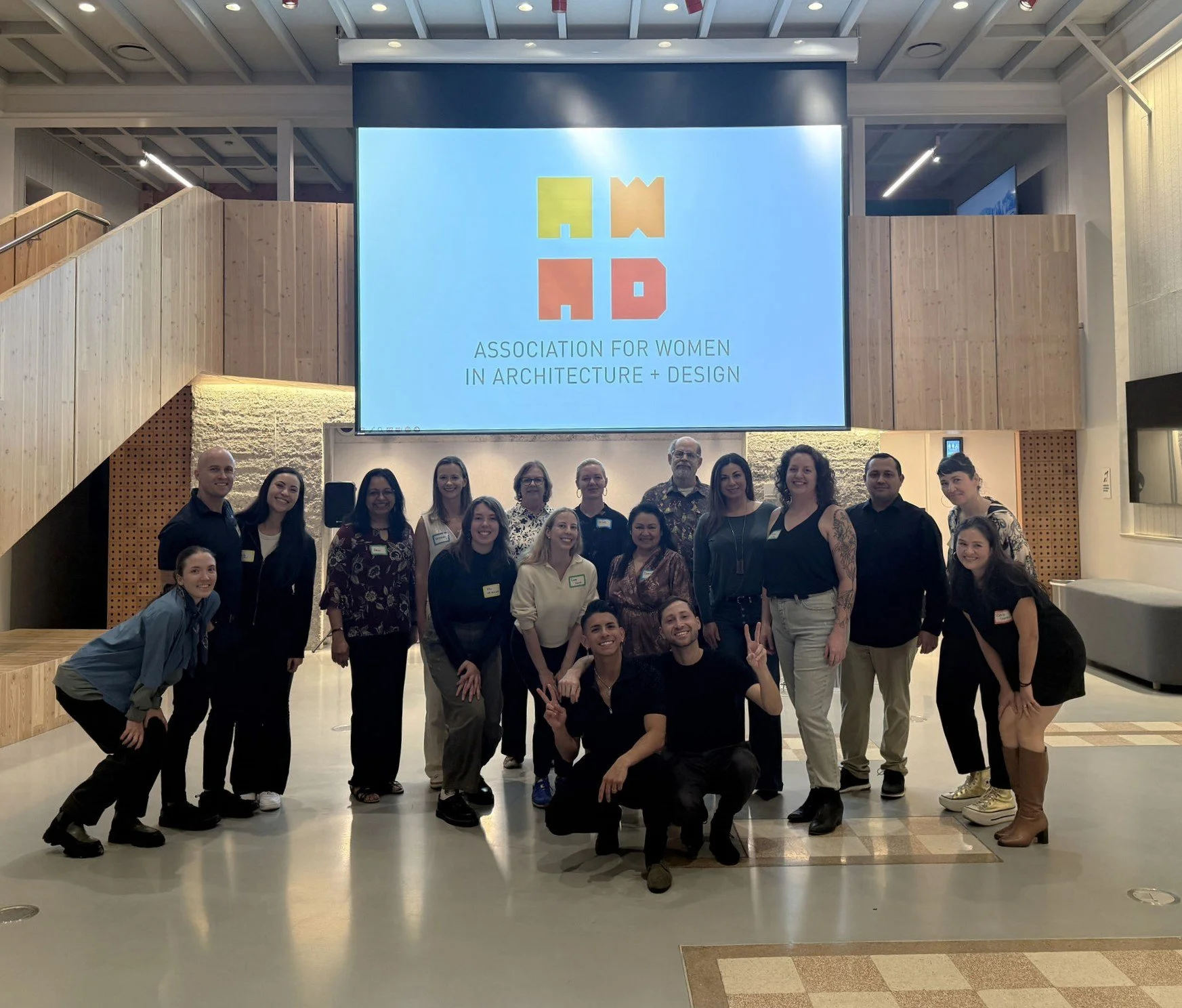
My first encounter with AWA+D as a true third place was at the New Year’s Celebration, where I was immediately welcomed by warm, familiar faces from across the Los Angeles architecture and design community and even a dance lesson. This salsa night was unexpectedly moving—watching professionals reconnect, laugh, and simply enjoy being together reminded me how vital these moments of shared joy in a third place are.
As I continued to grow in my career, I became more involved in AWA+D’s events. Each gathering offered space to build friendships and connect with peers who shared similar values and experiences. I love inviting friends along, but even when I attend alone, I know I will find familiar faces and meet new people. From childhood onward, we learn the basics of social interaction, yet we rarely consider how essential shared spaces are in shaping those skills. It’s through meaningful, repeated interactions in third places like AWA+D events that we build confidence, ease anxieties, and grow both personally and professionally.
In today’s world, loneliness and anxiety are increasingly prevalent. Many products and services are designed to address these issues, yet studies show that the average American spends more time on social media than engaging in real-life interactions.⁵ The cure to loneliness might not be another app, it might be stepping into a third place. A true third place transforms casual encounters into deeper conversations, which in turn become lasting connections. It is where we build relationships, gain new perspectives and, most importantly, share moments of joy.
For me, AWA+D has become that space. It is more than a professional network—it is a community. In a field where collaboration and connection are key, having a third place that nurtures both is invaluable. For those seeking connection, collaboration, or simply a space to belong, AWA+D provides more than a network—it is an evolving third place, shaped by the people who engage with it.
Perhaps the question isn’t just “Where can we find a third place?” but “How can we help create one?”
Disclosure: This post was edited with the assistance of AI.
JT Chuang is an architect based in Los Angeles. She studied Architecture at UCLA, and she is currently enthusiastic about Freak Nature Puppet.
Oldenburg, Ray, and Karen Christensen. “Third Places, True Citizen Spaces.” UNESCO Courier, March 22, 2023. https://courier.unesco.org/en/articles/third-places-true-citizen-spaces
Oldenburg, Ray. “Third Places in Culture.” Steelcase: 360 Magazine, 2024. https://www.steelcase.com/research/articles/topics/design/q-ray-oldenburg/
Pintos, Paula. “Revitalized Public Spaces: Fostering Human Connections in Cities.” ArchDaily, August 18, 2020. https://www.archdaily.com/945220/revitalized-public-spaces-fostering-human-connections-in-cities
Longhouse. New World Encyclopedia. Accessed 2026. https://www.newworldencyclopedia.org/entry/Longhouse
The Cigna Group. “Loneliness in America 2025: A Pervasive Struggle Requires a Communal Response.” 2025. https://filecache.mediaroom.com/mr5mr_thecignagroup/183661/2025-loneliness-in-america-report-the-cigna-group.pdf